Challenge Synthesis
← Observation-to-Take-away Mapping
This page provides the extended synthesis of recurring limitations, observed gaps, open challenges, and future research directions identified across the 125 primary studies.
The synthesis complements the result-level observations by showing how cross-cutting challenges recur across models, frameworks/libraries, compiler backends, and integrated AI applications.
Challenge Overview
The following table summarizes eight recurring challenge themes and their future implications. The themes are not mutually exclusive, and a single study may contribute to more than one category.
| Theme | Mapped take-away | Future implication |
|---|---|---|
| Input validity and constraints | T2 | Future fuzzers need stronger constraint-aware and semantics-preserving input generation for models, frameworks/libraries, compiler backends, and system-level AI applications. |
| Oracle construction | T3 | Future work should develop stronger semantic, numerical, metamorphic, safety-aware, and domain-specific oracles that can detect subtle failures beyond crashes or simple output differences. |
| Coverage and adequacy criteria | T2, T5 | Future studies need target-aware adequacy metrics that better reflect fault-detection effectiveness for model behavior, APIs/operators, compiler paths, and system-level interactions. |
| Scalability and efficiency | T5 | Future fuzzers should improve efficiency through prioritization, adaptive mutation, incremental execution, guided search, automated triaging, and scalable feedback mechanisms. |
| Benchmarking and reproducibility | T5 | The community needs shared benchmarks, artifact packages, and standardized evaluation protocols to support fair comparison and replication across AI-system targets. |
| Generalization across targets | T1, T2 | Future techniques should be evaluated across broader AI paradigms, datasets, frameworks, compilers, simulators, and deployment settings to assess transferability. |
| LLM-based fuzzing | T2, T5 | Future LLM-assisted fuzzers need better prompt design, output validation, repair, cost control, and feedback-guided generation to reduce invalid or unreliable tests. |
| System-level realism | T1, T4 | Future system-level fuzzing should improve realistic scenario generation and evaluate whether simulation-discovered failures transfer to real-world AI systems. |
1. Input Validity and Constraints
Generating valid, realistic, and meaningful tests remains a recurring challenge across AI-system layers.
Model-Level Inputs
For model-level fuzzing, generated or mutated inputs should preserve relevant semantics while still exploring failure-inducing behavior.
Examples include:
- DeepHunter (P032), where metamorphic mutations may not always preserve input validity;
- DEEPWALK (P061), which highlights the difficulty of preserving fine-grained annotations under perceptual mutation;
- CtrlFuzz (P012); and
- GENFUZZER (P025).
Generative methods can improve realism and diversity, but their effectiveness depends on the quality, controllability, and domain coverage of the underlying generator.
Framework/Library and Compiler Inputs
For frameworks, libraries, and compiler backends, validity depends on satisfying combinations of:
- API constraints;
- tensor shapes and data types;
- operator dependencies;
- model-graph rules;
- grammar requirements;
- intermediate-representation constraints; and
- optimization-triggering conditions.
Representative studies include:
Invalid tests often fail before exercising deep target logic. Input validity is therefore not only a preprocessing concern; it directly determines how deeply a fuzzer can explore the system.
Future priority: combine semantics-preserving generation with constraint inference, validity checking, and repair.
2. Oracle Construction
Oracle construction remains one of the most difficult parts of AI-system fuzzing because failures may be semantic, numerical, nondeterministic, or context-dependent.
Crash and exception checks are practical but may miss:
- silent logic errors;
- numerical inconsistencies;
- incorrect optimization behavior;
- semantic failures; and
- safety violations.
Differential testing can compare frameworks, versions, devices, backends, or implementations, but acceptable floating-point variation and platform-specific behavior may create false positives.
Metamorphic and specification-based oracles reduce dependence on exact ground truth, but they require relations and rules that may not generalize across domains.
Representative studies include:
- NNsmith (P001);
- Muffin (P009);
- FreeFuzz (P010);
- TensorJSFuzz (P003);
- DeepRoad (P049);
- QATest (P039); and
- π-fuzz (P041).
Future priority: develop hybrid semantic, numerical, metamorphic, safety-aware, and domain-specific oracles with explicit uncertainty and tolerance handling.
3. Coverage and Adequacy Criteria
Coverage-guided fuzzing is one of the dominant technique families, but coverage means different things across targets.
Model-Level Adequacy
Model-level studies use measures such as:
- neuron coverage;
- activation patterns;
- contribution coverage;
- behavioral diversity; and
- region-based coverage.
Examples include:
Framework and Library Adequacy
Framework/library studies may use:
- API coverage;
- operator coverage;
- branch coverage;
- function coverage; and
- low-level implementation coverage.
Examples include:
Compiler and Backend Adequacy
Compiler/backend studies may use:
- code coverage;
- IR coverage;
- pass coverage;
- optimization coverage; and
- directed reachability.
Examples include:
System-Level Adequacy
System-level testing may require:
- state coverage;
- trajectory coverage;
- scenario diversity;
- safety-related coverage; and
- behavior coverage.
Examples include:
The central gap is that higher coverage does not necessarily imply stronger fault detection.
Future priority: design target-aware adequacy metrics and evaluate their correlation with distinct, meaningful, and reproducible failures.
4. Scalability and Efficiency
Scalability limitations recur across the literature.
Model-level fuzzers may require expensive:
- gradient computation;
- coverage tracking;
- generative modeling;
- search; and
- repeated model execution.
Framework/library and compiler/backend fuzzers may require:
- constraint extraction;
- constraint solving;
- instrumentation;
- repeated compilation;
- cross-backend execution; and
- large-scale result comparison.
System-level fuzzing may be particularly expensive because each test can require simulator execution or long-running scenario evaluation.
Representative efficiency-oriented studies include:
LLM-based fuzzing introduces additional cost through generation, prompt iteration, validation, repair, and repeated inference, as seen in:
- TitanFuzz (P015);
- YANHUI (P023);
- FUEL (P082);
- NÜWA (P081); and
- the multi-agent fuzzing framework (P103).
Future priority: improve seed prioritization, adaptive mutation, incremental execution, feedback-guided search, bug deduplication, and automated triaging.
5. Benchmarking and Reproducibility
The literature uses diverse:
- datasets;
- models;
- APIs;
- operators;
- frameworks;
- compiler versions;
- backends;
- simulators;
- maps;
- scenarios; and
- evaluation metrics.
This diversity reflects the breadth of the field, but it also makes direct comparison difficult.
A model-level image-classification fuzzer cannot be evaluated in exactly the same way as a DL-library API fuzzer, compiler/backend fuzzer, or autonomous-driving scenario fuzzer. Even within the same target category, differences in benchmark versions, hardware, seeds, execution budgets, and failure-counting rules can reduce comparability.
Future priority:
- shared benchmark suites for each target layer;
- standardized reporting of budgets, seeds, environments, and versions;
- open implementations and artifact packages;
- common failure-deduplication and validation procedures; and
- target-specific but comparable evaluation protocols.
These needs motivate T5: reproducibility and benchmarking are essential for future progress.
6. Generalization Across Targets
Generalization is a major cross-cutting limitation.
Many model-level studies evaluate a limited set of:
- datasets;
- tasks;
- architectures; or
- input domains.
Framework/library studies often focus on selected APIs, operators, versions, or ecosystems.
Compiler/backend studies may be tied to a particular compiler, intermediate-representation dialect, optimization pass, or backend, including:
System-level studies often depend on selected simulators, maps, environments, or scenario sets, including:
- DriveFuzz (P066);
- AutoFuzz (P068);
- AV-FUZZER (P069); and
- the RL testing and repair framework (P164).
As a result, it remains difficult to determine whether a method transfers across AI paradigms, platforms, domains, or deployment settings.
Future priority: evaluate techniques across multiple targets, versions, datasets, architectures, frameworks, simulators, and real deployment conditions.
7. LLM-Based Fuzzing
LLMs create new opportunities for generating:
- programs;
- API calls;
- fuzz drivers;
- prompts;
- scenarios;
- constraints; and
- transferable bug patterns.
However, LLM-based fuzzers introduce additional risks:
- prompt sensitivity;
- output randomness;
- invalid generations;
- hallucinated APIs or constraints;
- inference cost;
- model-version dependence; and
- limited reproducibility.
Representative studies include:
- TitanFuzz (P015);
- YANHUI (P023);
- FUEL (P082);
- NÜWA (P081);
- DFUZZ (P002);
- MirrorFuzz (P078); and
- the multi-agent fuzzing framework (P103).
Future priority: treat LLMs as components in a generate–validate–repair–feedback loop rather than as fully reliable one-step test generators.
8. System-Level Realism
System-level fuzzing must balance experimental scalability with realistic behavior.
Autonomous-driving and reinforcement-learning studies often depend on:
- simulators;
- selected maps;
- simplified environments;
- limited weather or traffic configurations;
- predefined scenario spaces; or
- a small number of policies.
Representative studies include:
- DriveFuzz (P066);
- AutoFuzz (P068);
- AV-FUZZER (P069);
- the map-aware RL fuzzing approach (P125);
- ScenarioFuzz-LLM (P127);
- SimsV (P197); and
- FuzzScene (P198).
Simulation enables repeatable, large-scale testing, but failures discovered in simulation may not always transfer to physical or deployed systems.
Future priority: diversify scenarios and environments, incorporate real-world traces where possible, and evaluate the transferability of simulation-discovered failures.
Cross-Cutting Challenge Themes
Figure 1 highlights four broader themes identified across the selected studies:
- input validity;
- oracle construction;
- scalability; and
- generalization.
Because the themes are multi-label, a study may contribute to more than one category and the percentages do not sum to 100%.
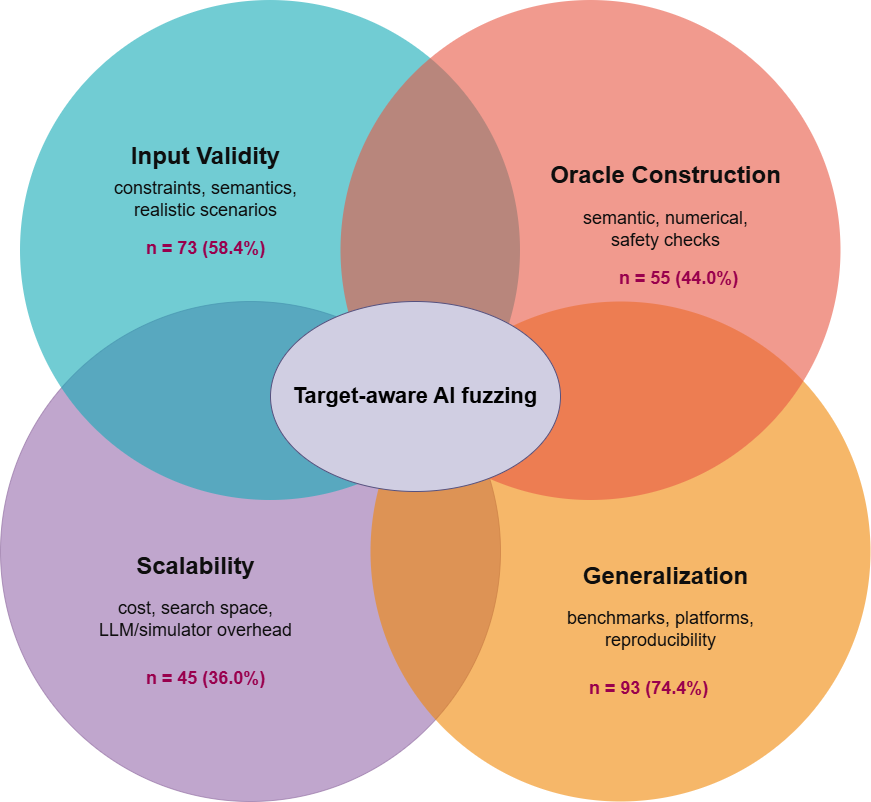
Figure 1. Venn-style synthesis of recurring limitation and open-challenge themes in fuzzing AI systems. Counts indicate the number of studies associated with each theme in the final corpus of 125 studies. The center highlights the need for target-aware methods that jointly address input validity, oracle construction, scalability, and generalization.
Future Research Priorities
The combined evidence suggests five broad priorities:
- Design target-aware fuzzing workflows. Different AI-system layers need different validity constraints, feedback signals, oracles, and failure models.
- Strengthen semantic and hybrid oracles. Future methods should detect subtle numerical, behavioral, safety, and security failures without relying only on crashes or simple output differences.
- Develop adequacy metrics linked to fault detection. Coverage should be evaluated by how well it supports meaningful failure discovery.
- Improve efficiency and reproducibility. Scalable search, prioritization, triaging, shared benchmarks, and open artifacts are necessary for cumulative progress.
- Evaluate transferability. Techniques and discovered failures should be tested across targets, versions, domains, simulators, and deployment conditions.
Connection to the Five Take-Aways
| Take-away | Challenge connection |
|---|---|
| T1 | Uneven target coverage and limited system-level realism motivate broader, cross-layer evaluation. |
| T2 | Input validity, target-specific assumptions, coverage adequacy, and LLM reliability shape technique effectiveness. |
| T3 | Partial specifications, heuristic checks, numerical tolerance, and domain dependence make oracle construction a central challenge. |
| T4 | Broader semantic, safety, security, performance, and domain-specific failures require richer detection mechanisms. |
| T5 | Shared benchmarks, reproducible artifacts, standardized protocols, scalable evaluation, and cross-study comparability are essential for future progress. |