Chronological Evolution of AI-System Fuzzing
This page provides the extended chronological overview associated with the survey Fuzzing AI Systems: Foundations, Techniques, and Open Challenges.
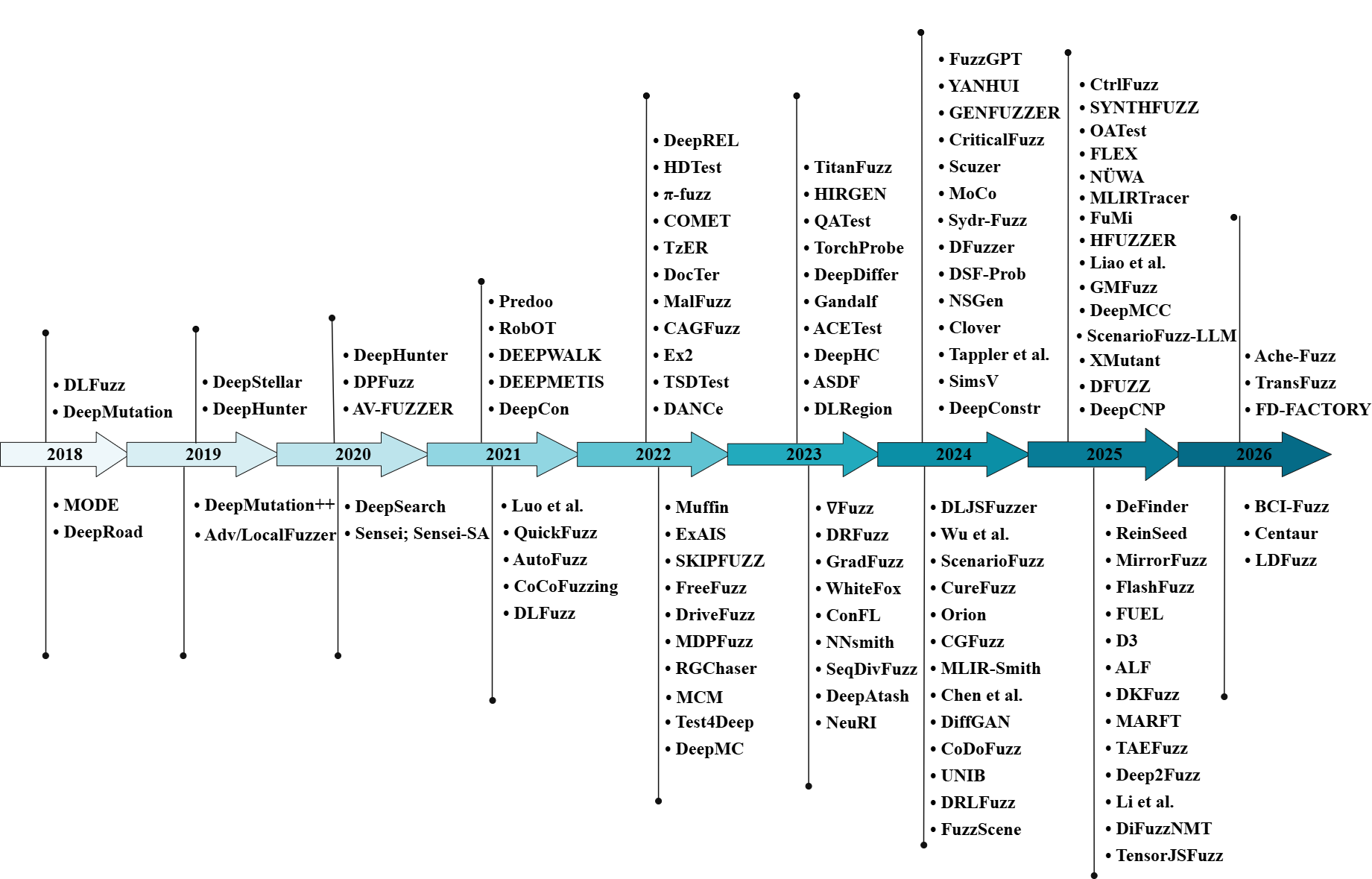
The overview organizes the 125 selected primary studies identified within the January 2015–February 2026 search window by publication year and presents the corresponding techniques or tool names.
The chronology complements the aggregate publication trend reported in the main paper. Early studies primarily focused on model-level testing using mutation-based, coverage-guided, and robustness-oriented techniques. From 2021 onward, the research landscape became increasingly diverse, with growing attention to frameworks and libraries, compiler backends, autonomous-driving and reinforcement-learning systems, and later LLM- and prompt-guided approaches.
The concentration of studies in 2024 and 2025 reflects not only increased publication activity but also broader coverage of AI-system targets and fuzzing techniques.
Chronological Overview
Interpretation
The chronology highlights three broad trends:
-
Early emphasis on model-level testing. Initial studies largely focused on DNN behavior, robustness, coverage, and semantics-preserving input mutation.
-
Expansion toward AI software infrastructure. Later studies increasingly targeted frameworks, libraries, APIs, operators, compilers, intermediate representations, and execution backends.
-
Emergence of system- and LLM-oriented fuzzing. Recent work extends fuzzing to autonomous systems, reinforcement-learning environments, LLM-based applications, prompts, agents, and multi-step interactions.
Together, these trends show that fuzzing AI systems is evolving from a predominantly model-centered research area toward a broader, cross-layer testing practice.